 Melmac
AI for life sciences, from batch record to product record.
Melmac takes the document-heavy work your quality, regulatory and commercial teams already do — extracts it into a schema they can review, matches it across supplier catalogs, and checks the AI run before anyone signs off.
Illustrative.
Batch release waits on a review backlog.
Every submission is re-typed from a PDF.
The same product has five different records.
Schema first. Then extraction. Then a person decides.
- Extract against a schema.A dry run returns the fields before anything is extracted. Missing values come back null, not invented.
- Match the product across catalogs.NDC, GTIN and supplier item numbers, with a confidence level on every pair and a queue for the edge cases.
- Keep one product record.Attributes, assets and channel mappings for regulatory, web and marketplace in one place.
- Check the output against a rubric.Grounded, cited, no invented facts. Every AI run gets a verdict before a person signs it.
- Stop the run that will not finish.Long document batches stop at the signal, and another model finishes the job.
- Leave a record of who did what.Claims, results and handoffs on one board, so review does not live in an inbox.
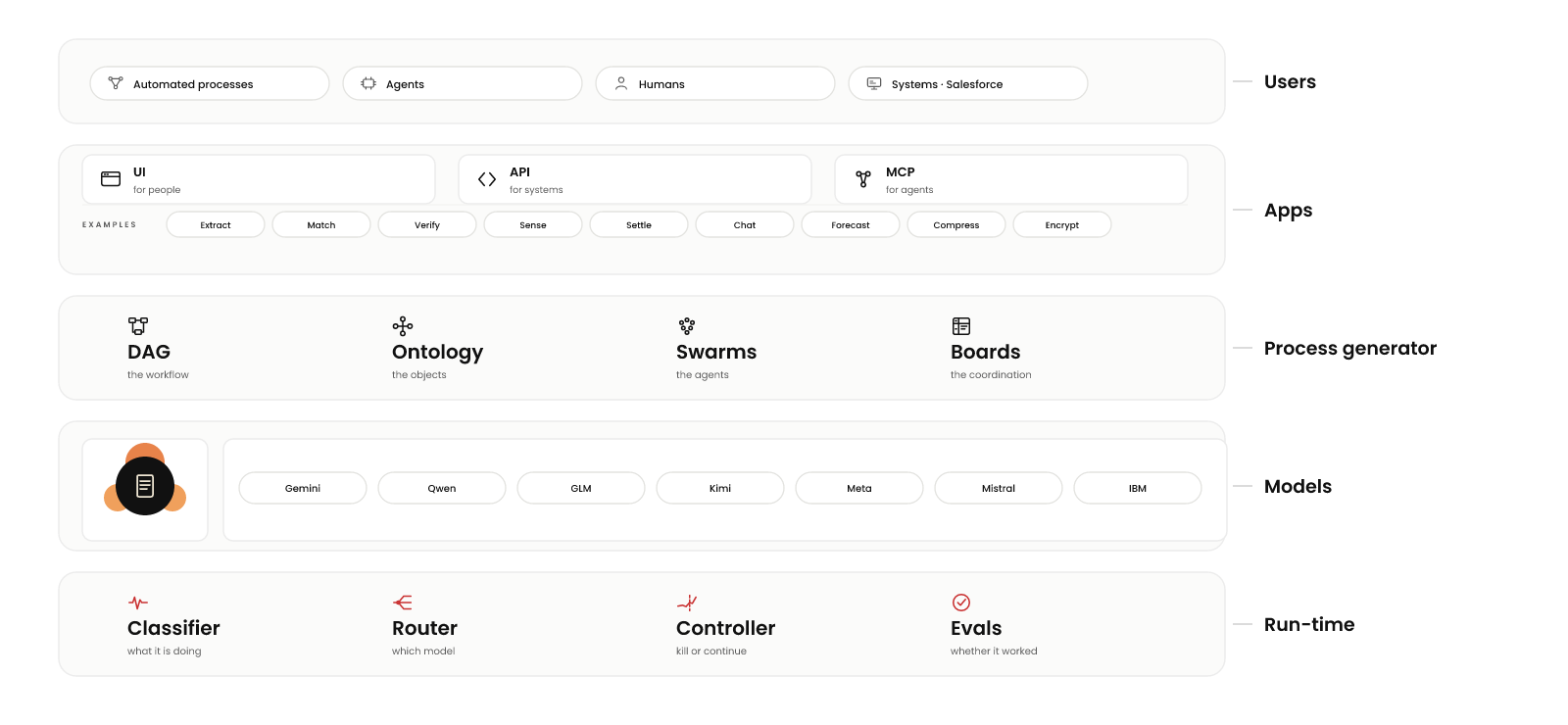
Every industry page uses the same stack. The vertical decides the schema, the rubric and the review queue.
Where a run starts.
Pick the document or data set that already has a queue in front of it.
Certificate of Analysis intake
Read supplier CoAs, pull the lot, assay, unit and expiry fields, and route anything below confidence to a reviewer instead of release.
Scope an extraction run →Batch record review
Turn a batch record into a checklist and a structured record. The AI checks and extracts; the human keeps the release decision.
Scope a review run →Stability and study reports
Extract timepoints, conditions and results from long reports into a table you can query, compare and reuse.
Scope a study run →Supplier and distributor catalogs
Match your item master to a distributor's catalog, with NDC, GTIN and pack attributes voting on every pair.
See Crosswalk →One product record
Keep the regulatory, commercial and marketplace versions of a product attached to one canonical record, not five copies.
See PIM →AI-drafted summaries, checked
Write a rubric for grounded claims and citations. A failed verdict stops the draft before it circulates.
See Evaluation →Built for the teams that own the evidence.
The common thread is not company size. It is a process where a person has to read the source before they sign.
Every run leaves a reviewable record.
Fields carry their source and confidence. Missing values come back null. Every match and every verdict is on the record, so a reviewer can check the work instead of trusting a number.
Controller reads the signal early and stops a run that is not going to finish.
The schema does not fill a gap with a plausible guess.
Catalog matches carry confidence, and the uncertain ones go to a person.
Agreed up front. You pay when the task is done.
| The question | A general agent | A Melmac run |
|---|---|---|
| Long PDF sets | Runs to the last page, then reports. | Killed at the signal; another model finishes the job. |
| A field that is not there | Fills the gap with a plausible value. | Returns null, and flags it for review. |
| A product across catalogs | Part numbers and a hunch. | Attributes, text and images vote; every pair is scored. |
| The review | A chat log and an inbox. | A board entry with an owner and a verdict. |
| The invoice | Tokens, metered. | One quote, paid on completion. |
A schema, a match, a verdict.
Illustrative dry runs, not client results. The shape is the point: the fields before extraction, the confidence on every pair, the person on the edge cases.
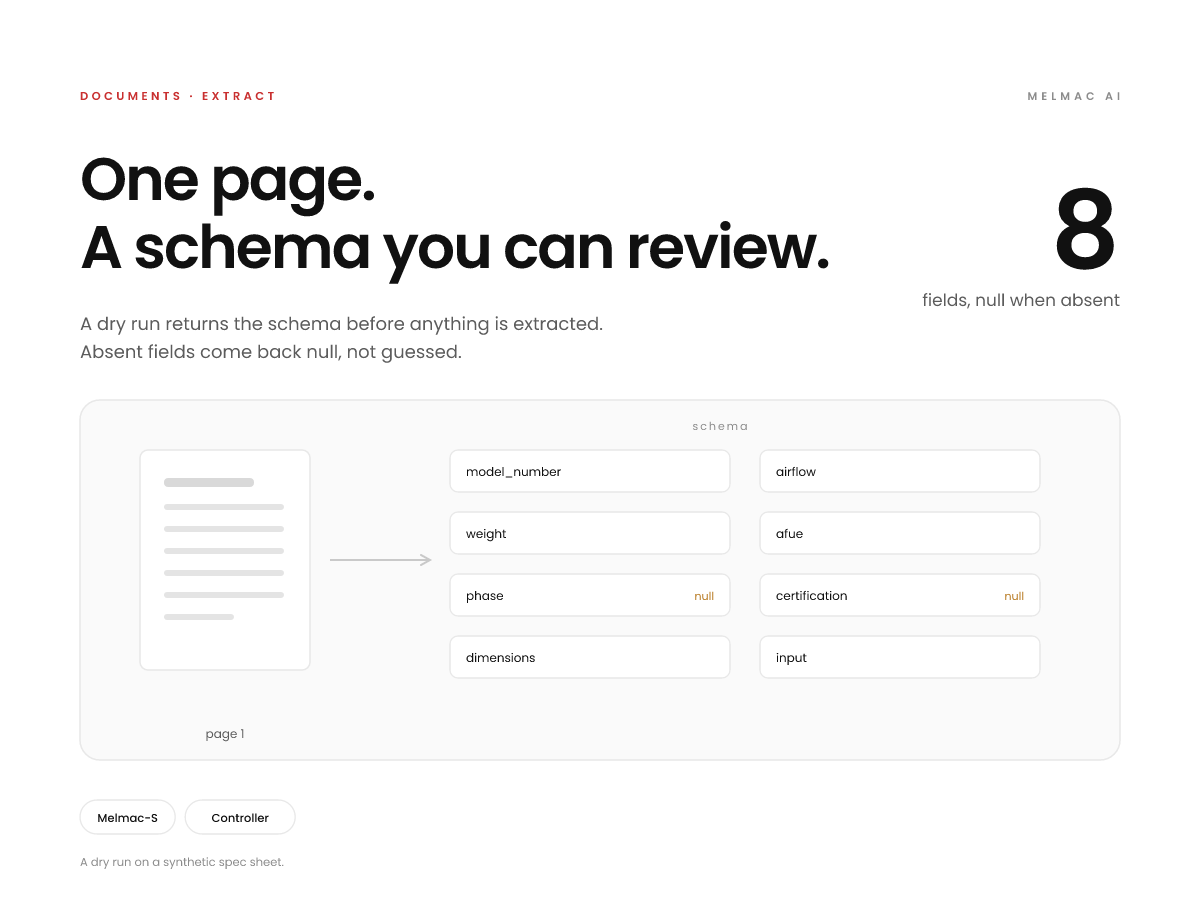
A schema you can review
A dry run returns the fields before extraction. Absent values come back null. Illustrative, on a synthetic spec sheet.
See the extraction approach →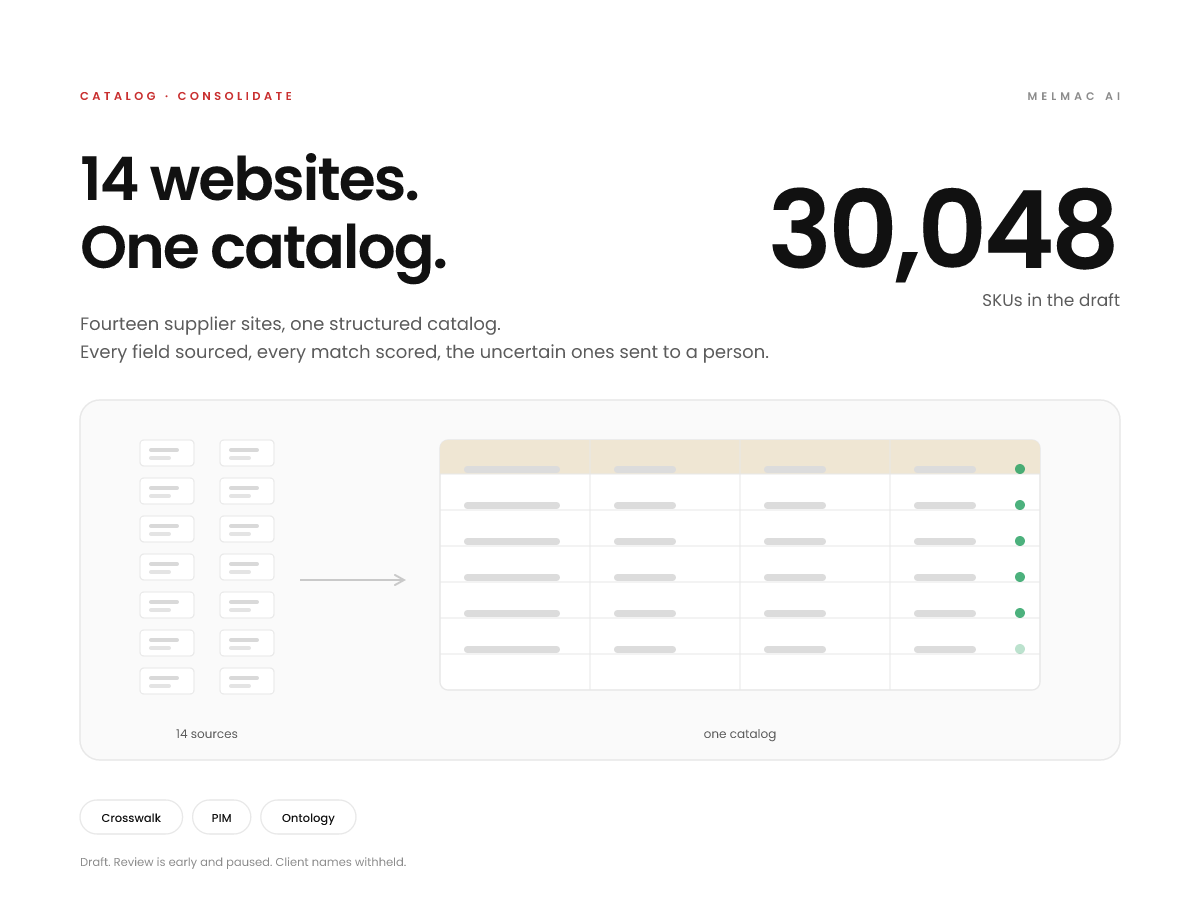
One catalog from many sources
Fourteen supplier sites into one draft; every match scored, the uncertain ones sent to a person. Draft, client names withheld.
See Crosswalk →Ask for the same dry run on one of your documents. We return the schema before anything is extracted.
What life science teams ask.
What is AI document automation for life sciences?
It is the use of AI to turn regulated life science documents such as certificates of analysis, batch records, stability reports and clinical study reports into structured, reviewable data. In Melmac, the schema is shown before extraction, missing fields come back null, and low-confidence values go to a person.
Which life science documents can Melmac process?
Typical starting points are certificates of analysis, batch records, stability reports, clinical study reports, labels and leaflets, safety data sheets, supplier qualification packs, deviations and CAPA records, and regulatory dossiers. We scope one document family first, not the whole archive.
How do you handle missing or low-confidence fields?
Missing fields come back null rather than guessed. Each extracted value can carry a confidence level, and anything below the threshold goes to a review queue instead of being accepted silently. The human decision stays in the process.
Is Melmac a GxP-validated system?
No. Melmac does not sell a pre-validated system. We build the workflow with your quality and validation teams, keep the human decision in the process, and leave a record of the run. Validation remains a joint exercise and is scoped in the quote.
How is this different from a general-purpose LLM?
A general-purpose LLM is asked to produce an answer. A Melmac run starts with a schema, returns null when a field is absent, scores every run against a rubric, and can be killed and rerouted when the signal says it will not finish. The output is built to be reviewed, not just read.
Can Melmac match NDC, GTIN and supplier item numbers?
Yes. Crosswalk normalises units, abbreviations and pack attributes, then matches on attributes, text and images. Every pair carries a confidence level, and low-confidence pairs go to a person instead of straight into the feed.
Where does our data run?
Melmac runs on Google Cloud. Deployment, retention, access and the data boundary are scoped per engagement before any data moves.
How do we start a life sciences engagement?
Pick one document type or one catalog pair. We run a dry run so you can see the schema or the matching rules before anything is processed, then agree a single price. You pay when the task is done.
Bring one document. See the schema.
One price, agreed before anything runs. You pay when the task is done.