 Melmac
Task, quote, run, done.
A fixed price only works if the work can be seen, checked and stopped. That is what the stack is for.
Tell us the task
And what done looks like.
We scope it
Shape, tools, model pack.
You get a quote
One price, agreed up front.
We run it
The runtime watches every step.
You pay
For the completed task.
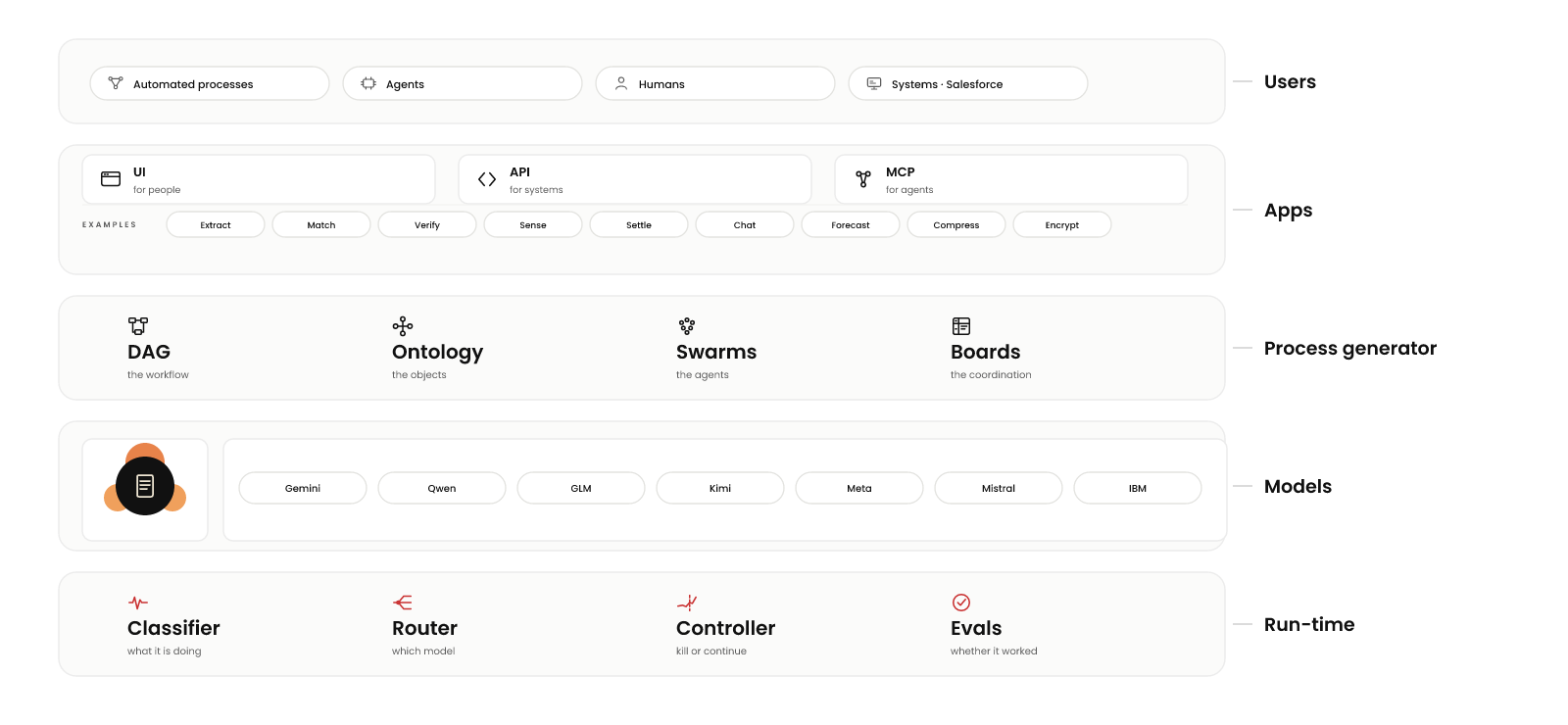
One system, end to end.
People, agents and systems at the top. Applications below them. The process generator and models underneath. The runtime across all of it.
Nine shapes of work.
The apps are examples built on these. A real job chains a few.
Extract
Messy documents in, structured records out.
Match
Two lists in, lined up with a confidence level.
Verify
A draft in, a checked draft out.
Sense
The physical world in, a model you can work on out.
Settle
A dispute in, a decision out.
Chat
A question in, an answer with sources out.
Forecast
Signals in, a forecast that explains itself out.
Compress
A long context in, the part that matters out.
Encrypt
Sensitive data in, work that never sees it out.
The model for the step.
The Melmac family handles the small, repeatable steps. Frontier and open models handle the rest. The runtime decides which one finishes the job.
Also routed: Gemini, Qwen, GLM, Kimi, Meta, Mistral, IBM.
GCP and OpenRouter.
Workloads land on Google Cloud. Models are called through OpenRouter where that is the better fit.
The model maker does not matter. Where it runs does.
Have a task? Get a quote.
One price, agreed before anything runs. You pay when it is done.