 Melmac
The runtime under your outreach platform.
Melmac does not replace the outreach platform you already run. It sits underneath the conversation: checking the reply before it reaches the customer, scoring every exchange, and stopping the runs that are going nowhere.
Illustrative.
An off-script reply reaches the customer.
A loop burns budget at 2 a.m.
Nobody can prove what the agent said.
Check. Score. Hand off. Keep the record.
- Check the reply before send.Controller reads the signal, predicts in the first 50 tokens, and kills or reroutes a turn that is going off-script.
- Score the conversation.A rubric per campaign for consent, tone, accuracy and the next step. Every conversation gets a verdict.
- Keep the handoff.Boards holds the claim, the result and the shared facts, so a human can pick up with context.
- Personalise the first touch.PartnerNote reads the target's site, cites what it finds, and drafts a note for a person to send.
- Route to the cheapest model that can finish.A run that will fail is stopped; the job moves to a model that can complete it.
- Leave a record of every run.What was said, what was checked, who took over, and why.
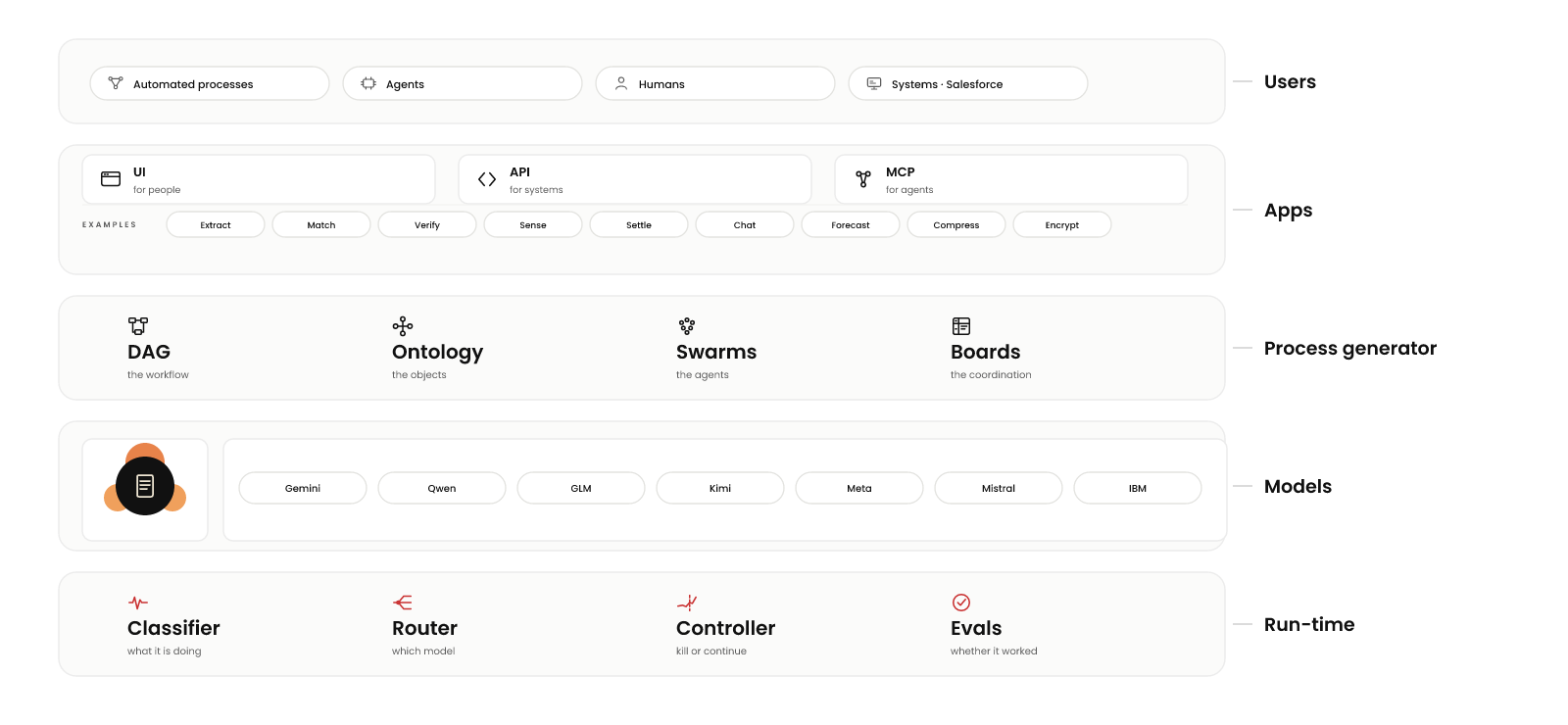
The platform stays in front. Controller, Evaluation and Boards run underneath.
Keep the platform. Add the controls.
The platform owns the channel, the compliance engine and the customer relationship. Melmac owns the run: should this response continue, which model should finish it, and was it any good? The platform stays in front. The runtime goes underneath.
AI for conversational outreach, without replacing the platform.
The same controls apply wherever a regulated conversation has to end in a real outcome.
Healthcare payers
Enrollment and retention replies that do not invent plan details. A low-confidence answer goes to a person, not a member.
Healthcare providers
Access and scheduling messages checked for accuracy and tone. Clinical questions are escalated, not answered by the bot.
Insurance
Payment reminders and quote follow-ups with a next step the policy actually allows.
Financial services
Refinance and collections conversations scored against the campaign rubric before they go out.
Higher education
Enrollment follow-ups with deadlines and aid details checked before send, and a handoff when the question needs a counsellor.
Contact centers and BPOs
Every agent run checked, every handoff recorded, and a cost ceiling that does not wait for the invoice.
Every reply leaves a verdict.
The check happens before send, the verdict is recorded against the campaign rules, and the handoff carries the context the next person needs.
Controller predicts whether the turn is worth finishing, before the rest is generated.
Not a weekly sample. A verdict on each exchange, against the campaign rubric.
Who took over, what was said, and what the next person needs to know.
Agreed up front. You pay when the task is done.
| The question | A generic bot stack | A Melmac run |
|---|---|---|
| The reply | Sent, then sampled. | Checked at token 50, killed or rerouted. |
| The quality score | A weekly sample. | A verdict per conversation. |
| The handoff | A transcript in a queue. | A board entry with an owner. |
| The cost ceiling | Discovered at the invoice. | Enforced during the run. |
| The invoice | Per seat, per token. | One quote, paid on completion. |
A reply, a verdict, a handoff.
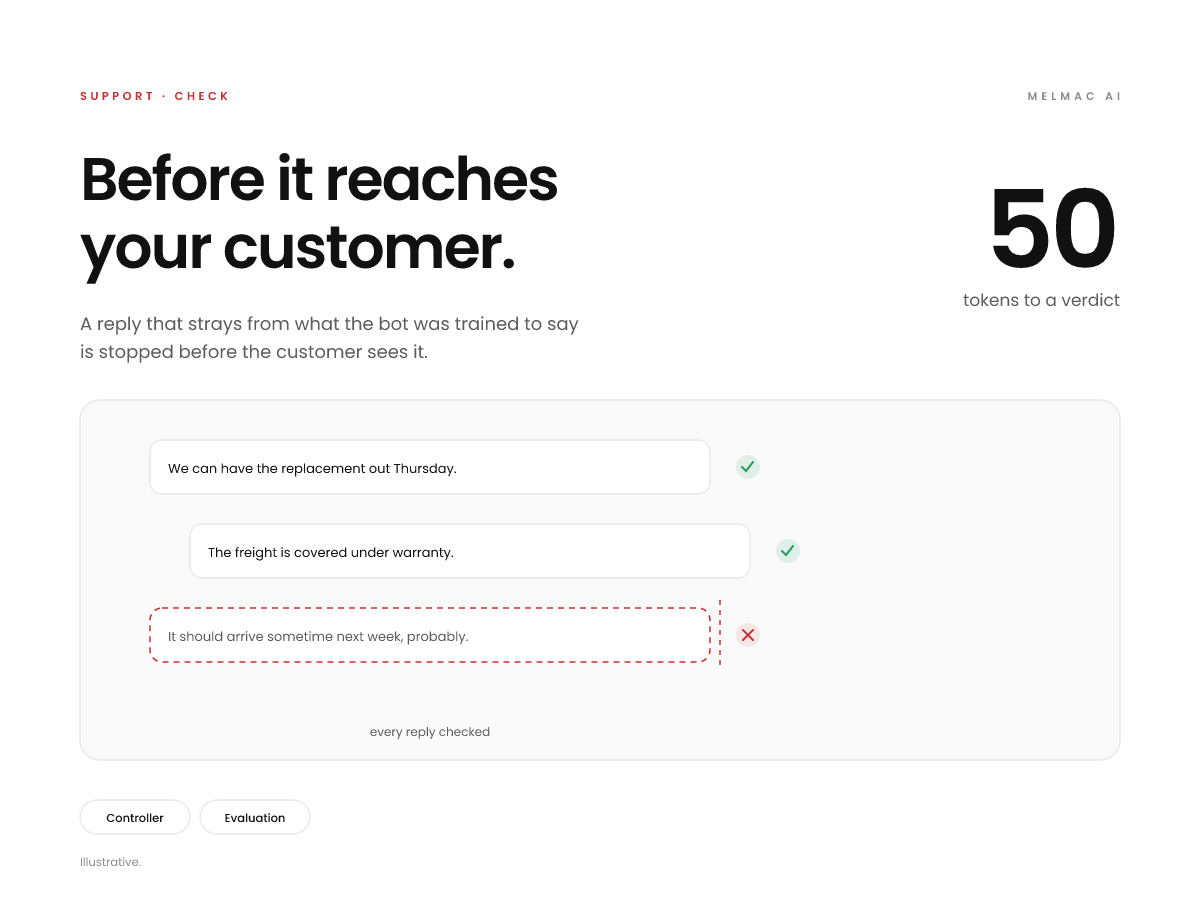
An illustrative dry run, not a client result: a reply that strays from what the bot was trained to say is stopped before the customer sees it.
Before it reaches your customer
Every reply checked, a verdict in 50 tokens, and a record of the stop. Illustrative.
See how Evaluation scores a run →Ask for a dry run on one campaign and one rubric. No customer data in the first pass.
What outreach teams ask.
Does Melmac replace our outreach platform?
No. Melmac is not a channel, a dialer or a CRM. It is the runtime underneath the platform you already run. The platform keeps the conversation, the compliance engine and the customer relationship. Melmac decides whether a run should continue, which model should finish it, and whether the output was any good.
What does the runtime actually do in a conversation?
Controller reads the signal and stops a bad run early. Evaluation scores the turn against the campaign rubric. Boards keeps the claim, the result and the handoff so a person can pick up with context.
Can Melmac stop a reply before it is sent?
Controller works at the run level. It reads the signal in the first 50 tokens and can stop and reroute before the platform sends. The platform still owns delivery.
How do you handle HIPAA, TCPA and CMS rules?
The platform's compliance engine remains authoritative. Melmac adds run-level checks and a record, and the compliance boundary is agreed in the quote. We do not claim to replace a compliance engine or a certification.
Which channels does Melmac cover?
The platform owns SMS, voice and email. Melmac checks the generated turn through the API or MCP and returns a verdict before delivery.
Can we use our own models?
Model choice is per step in the runtime. We scope the model pack with you rather than forcing a single vendor.
Does it integrate with our CRM, dialer or analytics stack?
Through the API and MCP. The integration is scoped per engagement.
How do we start?
Pick one campaign and one rubric. We run a dry run so you can see how a reply is scored before anything reaches a customer, then agree a single price. You pay when the task is done.
Bring one campaign. See the verdict.
One price, agreed before anything runs. You pay when the task is done.